Average Speed of freight Train over Indian Railways
Average speed of freight train is an indicator of mobility of motion on rail network. Average speed of passenger train depends on the time tabling. Average speed of passenger trains is steady over the last many years as narrated on Indian Railway passenger business post. http://globalrailelectrica.com/indian-railways/indian-railways-passenger-business/
The average speed of freight train is almost steady for the last many years. Has it reached its plateau?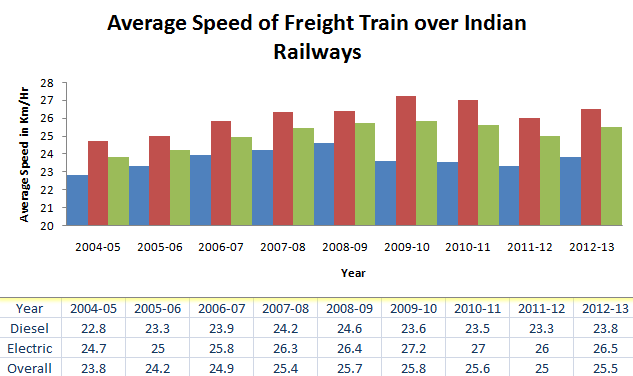

Factors responsible for Average Speed of Freight Train
- Running of freight train as Crack/Bullet train bypassing at least one crew changing point. The advantage is to avoid fresh train ordering which always result some time loss in the running of trains. But the system is always under strong criticism due to duty hours of train crew becoming more then the continuous working safe limit of 10 hrs.
- Reliability of rolling and fixed assets involved in the running of Trains. This has been a cause of concern and always debated as the most prominent factor for average speed. But the trend of equipment failure from 2004-05 has continuously showing downward trend. Why it could not make an impact on the average speed of freight train?

- Introduction of High Horse Power Locomotive plays a vital role in improving the average speed. GTKM/TE(Kg) is an indicator of the impact made with the introduction of high horse locomotive like WAG9, WAG7 and WDG2 class of locomotive or multiple operation of locomotive. The trend of GTKM/TE(Kg) during the last few years is as follows:
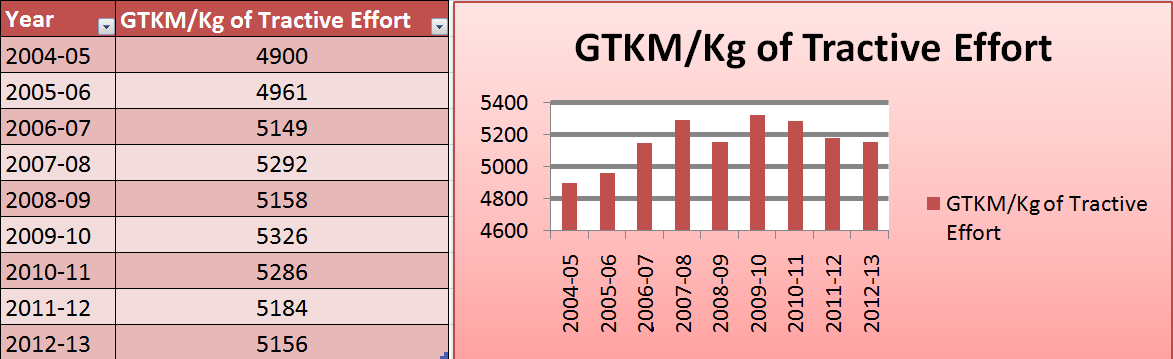
- There was 8.6% increase in 2009-10 as compared to 2004-05 but settled t 5.8% increase in 2011-12. It appears that improved HHP locomotive could not make use to run freight train at higher average speed.
- There is another factor which needs to be examined to assess the role of HHP on average speed. 35% of freight train motion is in Empty condition, meaning thereby that the HP/Weight ratio is much higher. But it does not make a difference in the average speed. This can be examined from the documents of average speed of Up and Dn direction in train route.
- Speed restriction of 15 Kmph at loops was having serious implication in reducing the average speed as well as sectional capacity. The turnout has been modified with one in 12 fan-shape layout fit for 30 kmph and should have certainly made positive impact in improving mobility of trains.
- During this period considerable investment has been made towards doubling/tripling and traffic capacity works for improving average speed of freight train. Is it not necessary for Railway management to find out, what impacts it has made on mobility of freight trains?
- But all this has not been able to make an impact on the average speed of freight train which has remained steady at 25 Kmph. There can not be any doubt that it is the average speed, the true indicator of mobility of trains, requiring serious brain storming to confirm whether it has reached its plateau.

Here are suggestion how to design an average speed of freight train and inputs planned to improve it?
-
Designed coaching corridor and push all coaching trains into coaching corridor. Run all coaching trains at the same average speed in the coaching corridor. This may need change of time-table of few trains from 30 minute to 2 hours.
-
This will free freight corridor and all freight train can run free of precedence for three to four hours.Running of crack/bullet train will become more purposeful in which the crew will complete its journey within 10 hours.
-
This will open up an opportunity to order all trains to run for a distance of at least 300-400 Km by the same crew.
You may also like:
- Average speed of freight train over Indian Railways
- Mechanized measurement and inspection – a help to cut down…
- Why no steps to digitize issue of free travel pass…
- ‘Rescue’ Indian Railway passenger business through statistical indices ‘RSKU’
- Where has 150 millions Indian Railway passenger gone?
- Why IR passenger traffic heading south?
We must have minimum average speed of all passenger trains as 50 kms per HR. Express trains at 100 kms per HR.
What a great work Mr Jain , what an enormous contribution to Rail-related data bank you have built-up !