Global Rail Network
I graduated in Electrical Engineering from University of Roorkee in the year 1976 and joined Indian Railways in the year 1977 through UPSC exam IRSEE-76. Worked in different position most importantly:
Electric Locomotive Maintenance and Operation in SER as Senior Divisional Electrical Engineer/ Rolling Stock TATA, BIA and BNDM, Operation CKP, Dy. CEE/OP and RS at HQ, Chief Electrical Loco Engineer/HQ
Divisional Railway Manager Ratlam
Executive Director/Power Supply and EMU/RDSO
Chief Electrical Engineer/ECR, NR, CR, Kolkata Metro
Adviser/Railway Electrification/Railway Board
Director/IRIEENs
Superannuated from Indian Railways on 30th June 2013
Synchronous Motor as Traction Motor
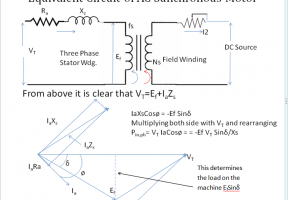
Last updated on April 5th, 2015 at 06:14 am Synchronous machines are used as Generator or Condenser motor and never as traction motor before advent of variable frequency drives. The motor consists of stater equipped with three phase stater winding and rotor with DC field excitation. DC field may be with salient or non-salient poles or with permanent magnet. […]
Three Phase Induction Motor as Traction Motor
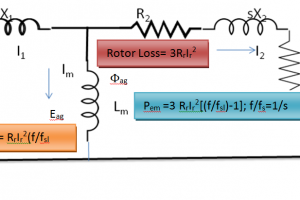
Last updated on April 5th, 2015 at 06:14 am Right from the introduction of electric traction, there was a strong desire to use Three phases Induction Motor for Traction application. This could only be possible with the introduction of variable voltage variable frequency control. Working Principle of Three Phase Induction Motor AC induction motor is […]
DC Series Motor as Traction Motor
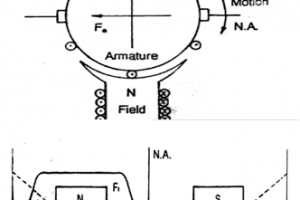
Last updated on April 5th, 2015 at 06:14 am There are two basic principles which governs the working of DC machine A current carrying conductor placed in a magnetic field experiences a force demonstrated by Lorentz Law. Direction of the force is given by Fleming’s LH rule. A voltage is induced in the conductor […]
Traction Motor

Last updated on November 21st, 2014 at 08:16 am Traction Motor is the most important part of any locomotive converting electrical energy into mechanical requiring sturdiness of electrical, mechanical, magnetic and insulation system for safe and reliable function. The constraints, limitation and challenges of designing a suitable traction motor are Envelope of Traction Motor Limitation […]
Braking Effort
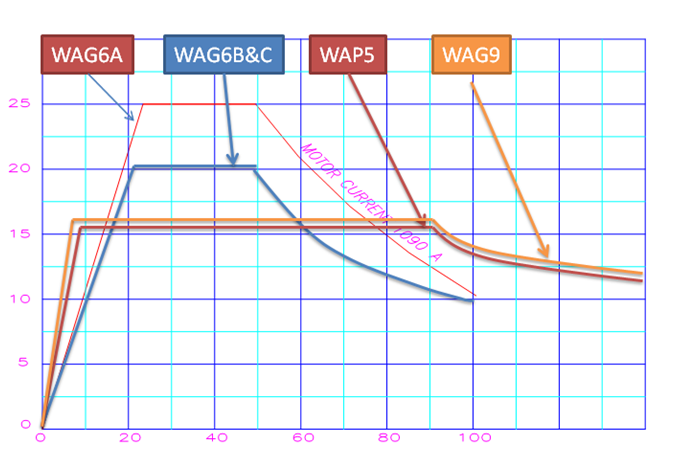
Last updated on April 5th, 2015 at 06:14 am Braking effort is the effort required to stop the train within safe braking distance. It has safety consequences. Braking effort is required to counter the kinetic energy of train running at a speed V and can be expressed as . where D is braking […]
Weight Transfer
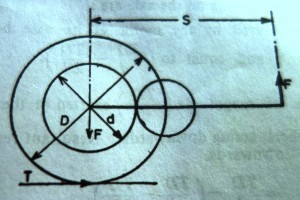
Last updated on April 5th, 2015 at 06:14 am When a locomotive is standing still on straight track, its weight is uniformly distributed on all axles but during traction, reactive forces and turning moments re-distributes the loading on each axle. System for transmission of Tractive effort from wheel to axle-bogie-body-draw bar pull results into non-uniform […]
Wheel Slipping and Sliding
Last updated on March 23rd, 2014 at 05:02 pm Wheel slipping occurs when tractive effort exceeds adhesive weight whereas sliding occurs when braking effort exceeds adhesive weight. In both the situations, it is the adhesive weight playing the most important role. Adhesive weight is defined as the force that can be exerted by a […]
Tractive Effort
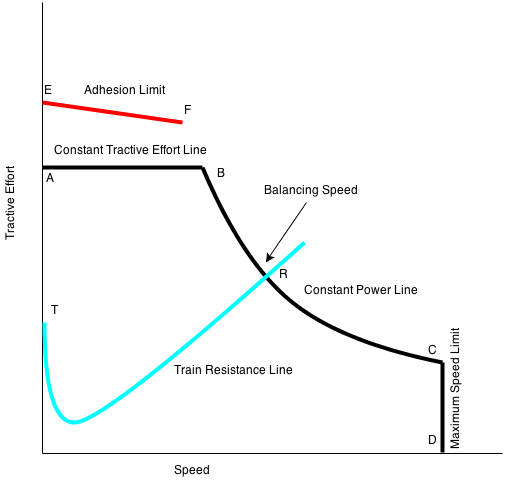
Last updated on July 29th, 2019 at 04:51 am Tractive effort is the force required to haul a load. Tractive effort, when multiplied with speed at which the train is required to run, gives the HorsePower. Importance of Tractive effort lies with its capability to start a train on the gradient and run it up […]
Train, grade, curve and Acceleration Resistance
Last updated on February 6th, 2017 at 10:19 am Trains resistance is defined in terms of force required to encounter resistance arising due to vehicle, track, grade, curve, acceleration, wind at different time and place etc. Study of these resistances and its impact in train motion is important to develop strategies for reducing it. It […]
Adhesion
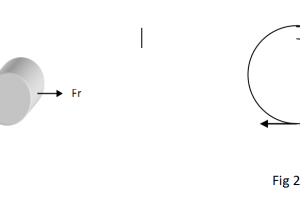
Last updated on April 5th, 2015 at 06:13 am Adhesion is one of the most important term used in Railways parlance signifying the ability of efficient heavy haul and safe braking. Adhesion limits the tractive and braking effort per traction and braking wheel respectively. On Indian Railways, adhesion limitation has caused more concern of wheel […]